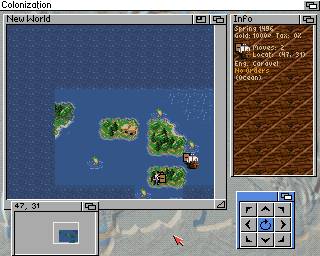
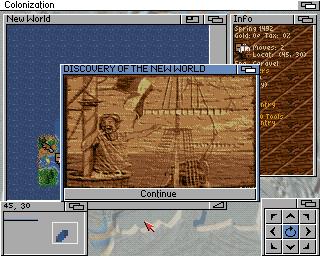
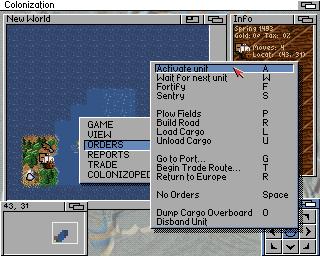
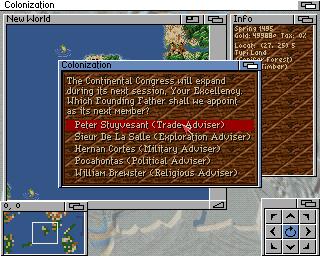
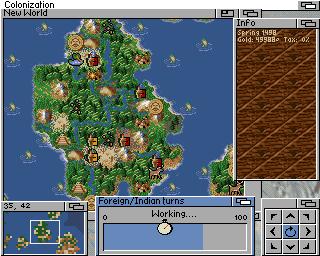
America, Land of the free, home of the brave. Or actually, at you will find out when your own pilgrim fathers first shuffle nervously ashore in the new world, home of the braves.
Colonization is the eagerly awaited Sid Meier instant classic, and is, in the broadest possible terms, a themed, specific version of one of his earlier efforts, Civilization.
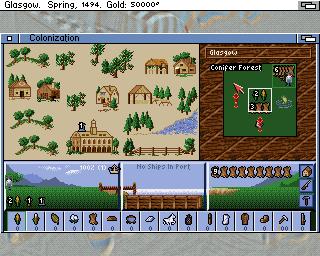
Just as in Civilization, your units (or colonists) must forge an empire, building cities, exploiting natural resources and defending themselves against the envy of less happy lands. The tactics are very different, though - you can easily be taken in by the familiarity of most of the game mechanics, but don't be fooled - this is not just Civ with new graphics, this is a completely new experience.
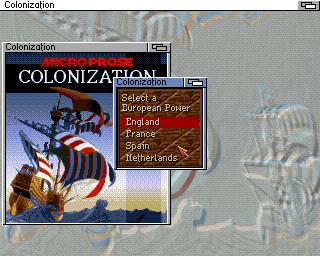
Each of the colonial powers starts with a different advantage. The English get a load of new colonists, the Dutch get a trade advantage, the French are better at getting along with the natives and the Spanish are better at killing them.
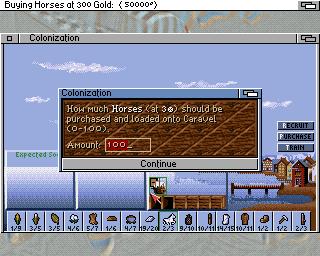
The trading aspect is much more important to Colonization than it was in Civ. There is no wealth derived from taxation - all taxes go straight to the king. To make money to buy more ships, recruit specialists from
Europe or import necessary resources (particularly early in the game, when you are not able to produce things lor yourself) you have to have something to sell, and that can only come from farming, mining, or manufacturing in your colonies.
Trade is a major part of this game which means you must send wagon trains scurrying backwards and forwards across the continent, ferrying goods to port or raw materials to factories. This could have been tedious, but you can set up automatic trade routes which are like railways in Railroad Tycoon - a series of stops, with loading and deliveries specified at each stop.
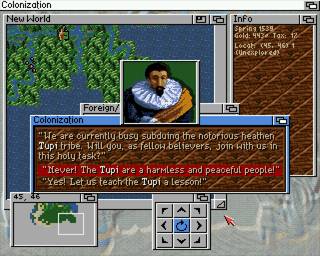
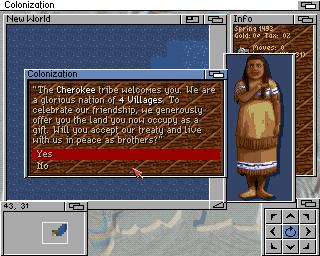
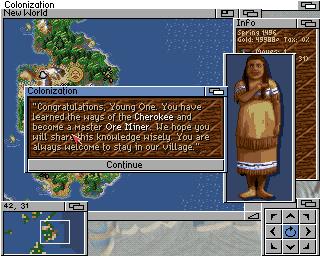
This can bring you into conflict with other powers in the area and the indigenous inhabitants - the Indians. Several tribes are represented, each with slightly different characteristics and abilities. There are the Incas and the Aztecs, with huge, rich cities; the rather primitive but friendly Tupi; the violent (when aroused) Iroquois and the plains Indians, the Apache, Cherokee and Sioux.
This is one example of the way the game really separates into two diverging paths, depending on the strategy you use. You can be friendly with the indians - trade with them, establish missions, learn skills from them - or burn thoir villages, murder their women and children and steal their gold (which can be a tempting option, especially as a raid on a rich village can produce more wealth than several years of hard trading).
The trouble with trying to be friendly is that the methods you need for colonising the continent put you at odds with the taboos of the natives. They are all over the place, so you can't put up a road or chop down a forest without upsetting someone. But if you do try to keep on their good side, they won't raid your villages, steal cargo from wagon trains and generally make nuisances of themselves. If your missionaries (and sometimes your muskets) manage to instill in them a fear of God and light cavalry, friendly indians will flock to your colony and can be persuaded to exact extreme vengeance on your foes.
Indians can also be a very cost-effective way of training up colonists. The majority of malcontents setting sail for a new life in the colonies have no skill or trade. Some are only good at thieving and some are "indentured servants", which is a polite way of saying 'slaves'. Since the game is quite honest about how the colonists abused the trust of natives and robbed their land, it seems a bit odd they didn't own up to exploiting native Africans too.
Anyway, a trained sugar planter, for example, can produce more sugar per field than a novice, or a slave, or indeed a lumberjack or farmer. There are five ways of getting an expert to tend your cane: train one up (expensive), wait for one to emigrate by choice (may take a while), get him trained by some friendly indians (if there are any nearby, and if they are friendly), teach him in a school or college (requires an expert teacher) or just leave him to it and hope he acquires the skill (wait a very long time). If you can get skilled colonists, it can make all the difference.
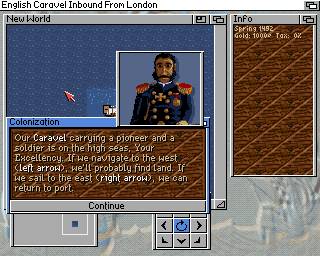
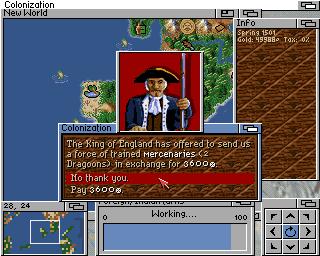
Of course, once you have manufactured your goods they still have to get back to Europe for you to make a decent living. On the high seas your Merchantman could fall prey to pirate ships, sponsored by enemy nations.
You can get in on the act too, though, and run your own privateers, looting and pillaging European cargo vessels without having to declare open war on another nation. It is a rather risky business, as players of Meier's own Pirates! will no doubt remember. But money alone won't buy you success.
The idea of the game is to settle a new, independent continent between 1500 and 1800. If you don't declare independence you won't get a decent score. You can't turn traitor until over 50% of the population want to become a nation of ingrates, and even when you do, you'll have to fight off a large number of the King's lackeys in a final, fitting end-phase. Terrific stuff.
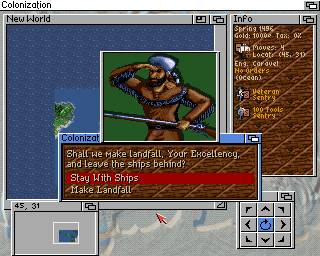
An astounding difference between this game and previous MicroProse efforts is its Amiga-friendliness. You can play Colonization in a variety of different screen modes, or on top of your Workbench if you so wish. I even managed to use EGS software with the Rainbow III card to shift the display on to an 800x600 VGA display, no problem. The windows can all be moved around or shunted backwards and forwards, and the main screen can be resized, albeit only slightly. This makes the game much more playable - it's a marked improvement on the PC version.
Sid Meier is a hero for many, not just because his inspired games are excellent, but also because in spite of the breadth and depth of titles like Railroad Tycoon and Pirates!, they all run on an A500 in 1Mb. How is it possible? It takes talent, I guess. Actually, Sid can't take all the credit, because the Amiga version was actually written by Scott Johnston.
The big thing people whinge about these days is how long the computer takes to make its move. Even in the latter stages of this game, the computer movements only take about a fifth of the time of your own. It's not as though you have to wait around anyway, because the calculations are usually broken up by several messages about new cargoes being ready, ships arriving in port, Indians ambushing your wagon trains - that sort of thing.
The game is a rich and varied Gestalt of top colonial activity. Strategies must bo divined with care, and constantly modified to ride the chaotic rapids of the thousands of interacting elements in this opus of creative genius. Perhaps. Or it could just be a damn fine game.
How to run this game on modern Windows PC?
People who downloaded Colonization have also downloaded:
Civilization AGA, Civilization, Colonization for Windows, Centurion: Defender of Rome, Dune 2, Colorado, Cannon Fodder 2, Cannon Fodder
©2024 San Pedro Software. Contact:  , done in 0.005 seconds.