
There's a really nifty bit in Clash of the Titans when Zeus (aka the late Laurence Olivier) becomes angry with a certain, rather callous King for casting his earthly son Perseus out to sea to die. By way of retribution the white-bearded Ruler of the Gods releases the awesome Kraken on the monarch's beachfront kingdom. As the Kraken rises from the sea, it creates an enormous tidal wave which utterly destroys the city.
It's awesome destruction such as this that forms the very heart and soul of Populous II. Bullfrog's long-awaited sequel is bigger, badder and - yes, better - than the classic original. Though at the most basic conceptual level, nothing much has changed, such drastic sweeping enhancements have been made in terms of sheer scope and invention that Populous 2 makes its 1989 dad look positively mediocre by comparison. And while those who fell under the original's spell may find that a little hard to swallow, it is absolutely the case. Really really.
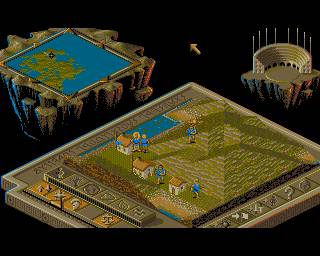
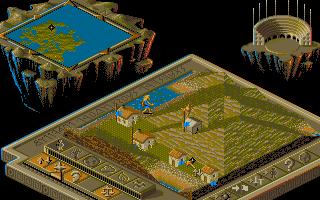
One of the game's many favourable aspects is that Populous players will be able to settle in nicely with the minimum of fuss because, as mentioned before, the basic idea and objectives remain the same. Two opposing Gods representing the forces of Good and Evil respectively, battle it out for ultimate supremacy over a series of isometric landscapes, or "worlds". Not directly of course - deities are far too important to ever get their own knuckles grubby - but via the poor God-fearing population that live down on the planet. Split into two distinct tribes - one worship- ping the player, the other the followers of the opposing deity, these misguided souls would like nothing more than to kick the stuffing out of the "infidels" across the water. All they need is a little help and guidance... It's like a great cosmic chess game played on a global scale, where real people are the pawns. And though they can't be controlled directly (this "free will" business can be a bit of a bind at times), they can be given divine nudges in the right direction. And of course, as Populous players will remember so fondly. Gods with sufficient power can take it upon themselves to intervene directly, unleashing awesome ethereal effects on the enemy's people and terrain. Earthquakes, volcanoes and all manner of horrid weather conditions can all be unleashed from the tip of the finger to create untold destruction and hassle for the opponent.
As in the original game, the trick to Populous II is to best exploit this free will stuff. Starting with just a couple of followers and minimal supernatural powers, a fledgling deity's initial objective is to flatten land - the game world is initially a rather mountainous affair, and hills and valleys must be levelled out in order for people to settle. Such manipulation of terrain is the most basic of all godly functions. As more flat land becomes available, the peoples' settlements grow larger, allowing nature to take its course and the population to expand accordingly. Two people become ten, twenty, a hundred and more, with each one setting up camp and producing more and more people. As the population expands, so the player becomes more powerful, as a deity's influence is derived directly from the faith, or manna, he receives from his followers. The larger a deity's population, the more scope he has for Godly effects. And of course a sizeable population is useful in case the two opposing tribes come to blows. The game is won when every last member of one of the tribes is killed, so a large population, spread out over a wide area makes it all the more difficult for the player's opponent - be it the computer or a pal connected on another computer - all the more difficult to win.
One of Populous II's minor changes - albeit an important one -is that not all people are the same. In the original game everybody was identical in terms of appearance and ability (which led to a few interesting questions about how the all-male population managed to procreate so successfully). Now the population is made up of three different types of character - men are the most basic, being a general all-purpose being with a particular edge when it comes to fighting. Old men are recognisable by their white beards and are a naturally weaker breed, moving more slowly and putting up less of a fight in combat. Women suffer from the same problem - a man will always have the upper hand against one in a fight - but they are much more resourceful during peacetime, finding it easier to locate land for settling. No doubt if the game had cooking and washing-up in it, they'd be better at that too.
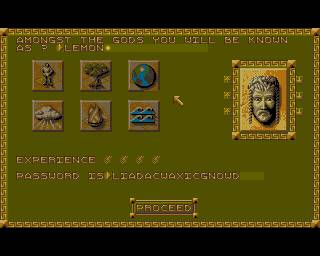
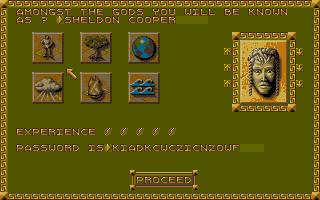
It's in the "special effects" department that Populous II's most radical and impressive new elements arc to be found. Forget about the paltry handful of godly acts that the original game offered - in Populous II the player can exert his divine influence in over 30 different ways, from the most harmless little touches to utterly devastating natural disasters. The effects are split into six distinct groups - People, Vegetation, Earth, Air, Fire and Water, with a variety of actions available within each. At the most basic level the player can plant trees and parkland, which improve the look of the area and make the people who live there happier, subsequently increasing the manna the player receives from them. Such environmental improvements can be taken further, as far as creating entire cities by laying down road networks and building protective castle-style walls around settlements. It's immensely satisfying to build an empire of this kind, as it gives an impression of being much more sophisticated, networked and citylike than the random scattering of settlements that previously formed the deity's population.
Vital though they may be, however, these "housekeeping" style effects are all pretty mundane when compared to those that can be found at the upper end of the scale. We're talking real awesome destructive power here. Many of the offensive effects arc remodelled versions of those found in the original - Swamp. Earthquake. Volcano, Knight and Armageddon arc all in there, filed under the relevant group headings, and all differ in some degree from their Populous counterparts. While the
It's been said before, and I'll say it again - Populous II makes the 1989 original look somewhat shabby by comparison, so great are the enhancements and additions that have been made. Perhaps the most obvious difference is the in the graphical department, where Populous II's visuals are not just a prettier face - they work better within the game itself, with effects like Earthquake and Volcano being considerably enhanced by the sophisticated way in which they are presented on screen. Some may argue that there's not enough radically new "stuff" to make Populous II sufficiently different from the original. It's worth remembering, however, that a totally new approach could well have been disastrous, as the original's formula was far too good to put to waste. Populous II pushes the potential of its novel display format far more than the original game did, while retaining the basic gameplay that made the whole thing work in the first place. For getting that mix of new elements and old just right, Populous II deserves special commendation.
How to run this game on modern Windows PC?
People who downloaded Populous 2 have also downloaded:
Populous 1, Powermonger, Pirates! Gold AGA, Zak McKraken and the Alien Mindbenders, Pirates!, Moonstone: A Hard Days Knight, Prince of Persia, Pinball Dreams
©2026 San Pedro Software. Contact:  , done in 0.001 seconds.